Residential heating service
Furnace Repair Akron OH
For Akron homeowners whose furnace stopped heating, will not turn on, is blowing cold air, cycles on and off repeatedly, makes unusual noises, or leaves some rooms cold.
Call now FOR FREE QUOTE and for service availability.
Please have your 5-digit ZIP code ready.
Residential Furnace Repair
Focused on homes, not commercial or industrial heating equipment.
Akron & Nearby Communities
Akron plus surrounding Summit County and neighboring cities.
Gas & Electric Furnace Problems
Ignition, flame sensing, elements, blowers, controls and airflow.
Repair vs Replacement Guidance
A structured comparison using your own estimates, not generic pricing.
Service Availability by ZIP Code
Call with your 5-digit ZIP code to check current availability.
What Is Your Furnace Doing?
Pick the symptom that matches your furnace. Each guide explains the likely causes, the checks that are safe for homeowners, and when diagnosis makes sense.
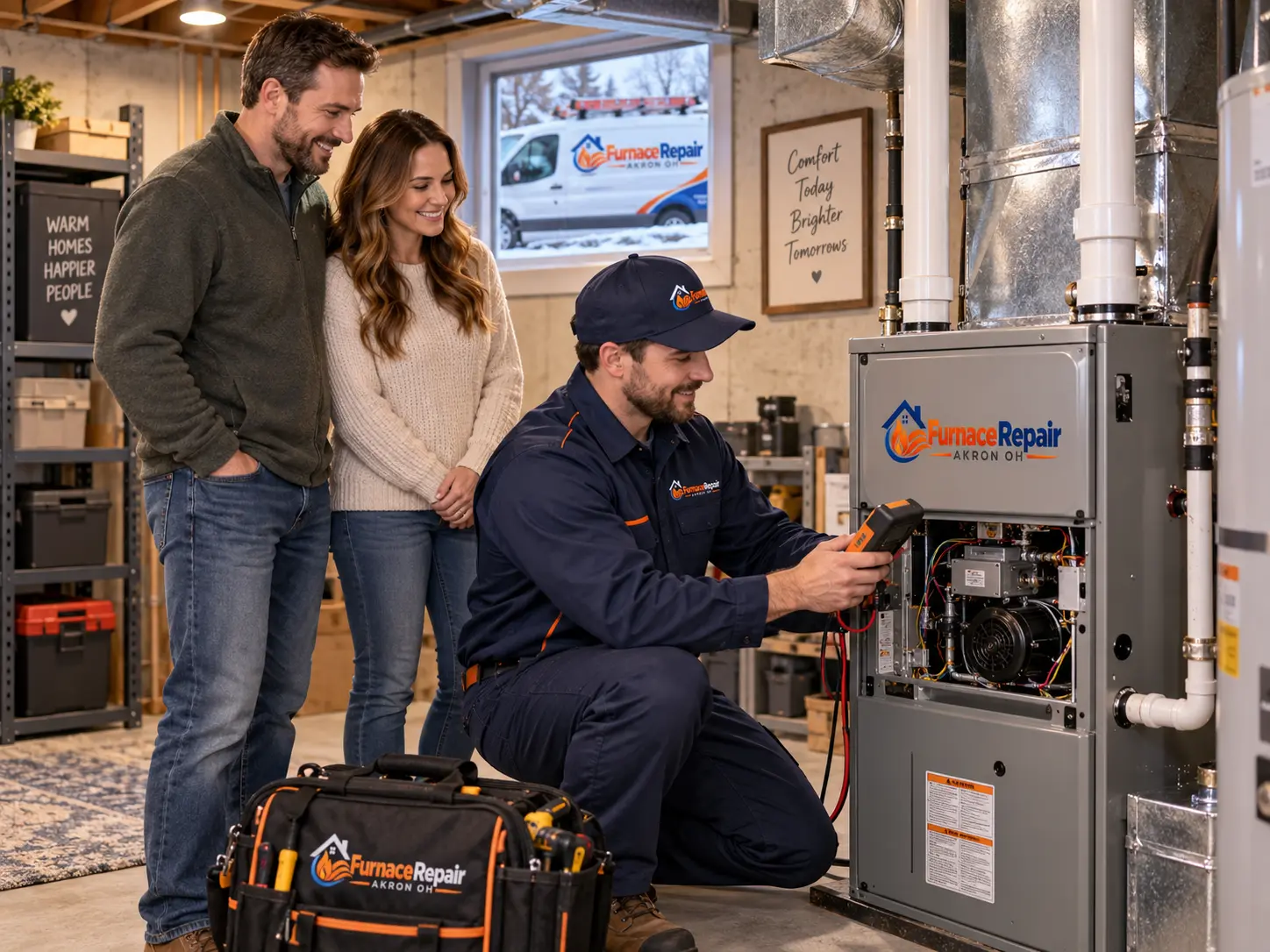
Residential Furnace Repair in Akron
Furnace problems can involve any part of the heating chain, and a careful diagnosis works through them in order rather than replacing parts on a guess. Depending on the symptom, the cause may sit in the:
- thermostat
- air filter
- ignition system
- flame sensor
- burners
- limit switches
- blower motor
- capacitor
- control board
- gas valve
- venting
- airflow path
- heat exchanger
- electrical components
Not every repair is available for every system or situation. Parts availability, system condition and safety findings all affect what makes sense, and you get the findings before any work continues.
Main Parts of a Home Furnace
Knowing the major components makes a diagnosis much easier to follow.
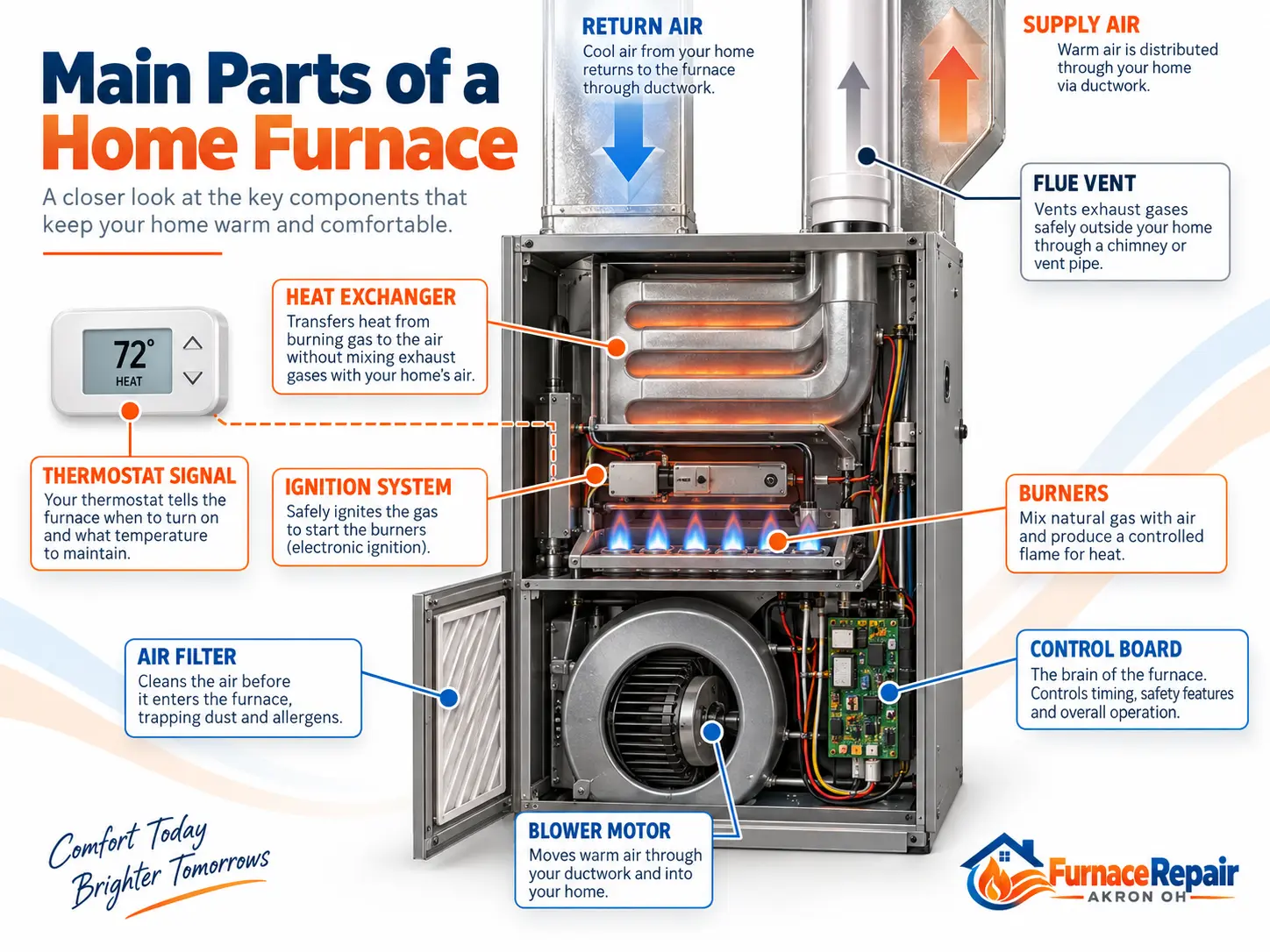
- Thermostat
- Sends the heating call that starts every cycle and holds it until the setpoint is reached.
- Air Filter
- Protects the blower and heat exchanger. A loaded filter restricts airflow and causes overheating.
- Burners
- Mix gas with air and produce the controlled flame that heats the heat exchanger.
- Ignition System
- Lights the burners, usually with a hot-surface ignitor, a spark electrode or a standing pilot.
- Flame Sensor
- Proves flame is present within seconds. Without proof, the control board closes the gas valve.
- Heat Exchanger
- Transfers heat to your air while keeping combustion gases separate from it.
- Blower Motor
- Moves heated air through the ducts and pulls return air back to the furnace.
- Control Board
- Sequences the whole cycle and stores diagnostic fault codes.
- Flue / Venting
- Carries exhaust gases safely outside through a chimney or PVC vent piping.
- Return Air
- Brings cool household air back to the furnace. Too little return air limits everything downstream.
- Supply Air
- Distributes warmed air to registers throughout the home.
Common Furnace Problems
These are common winter furnace problems in Akron-area homes.
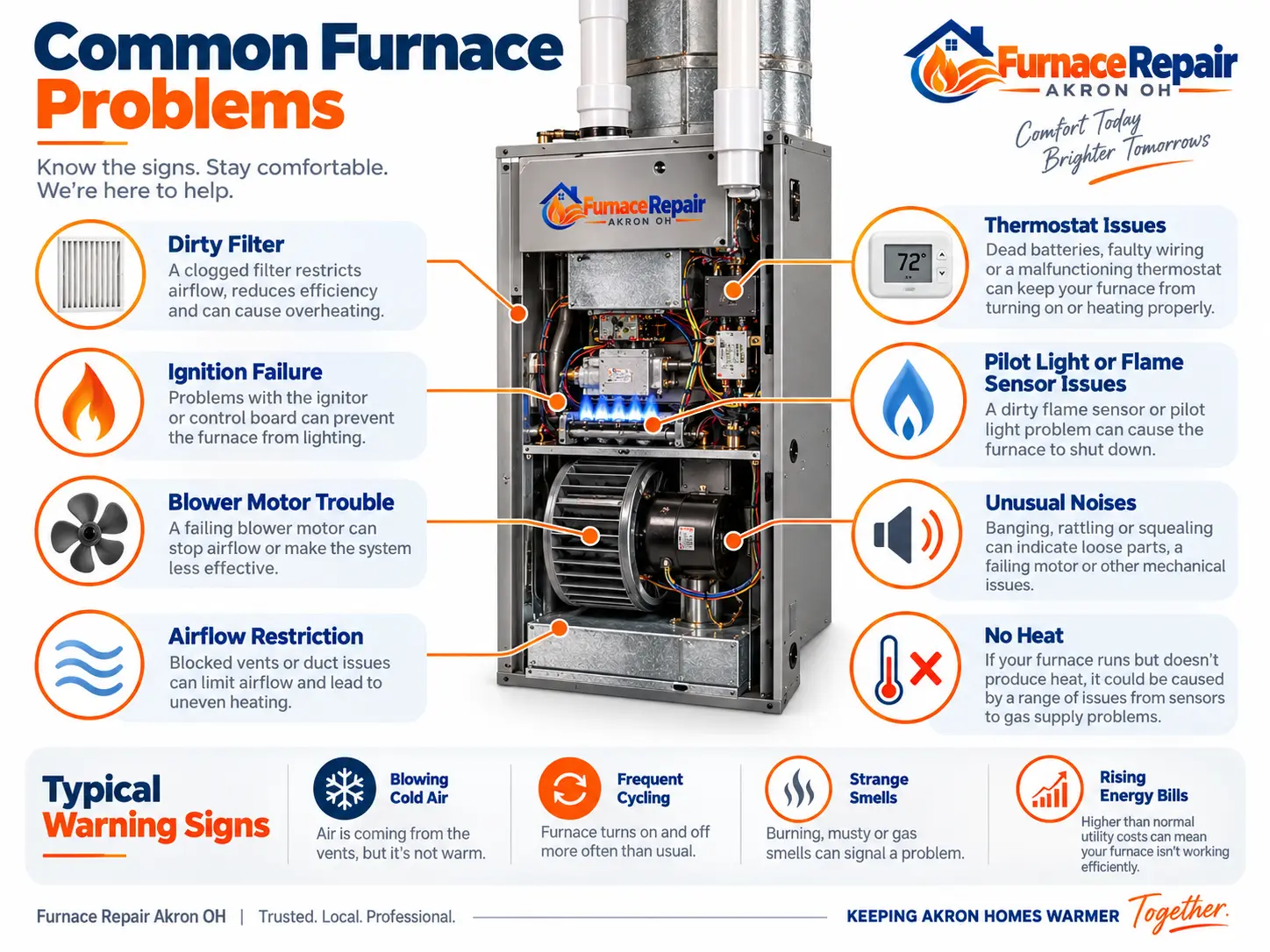
Dirty Filter
Restricts airflow, reduces efficiency and can cause overheating.
Read the dirty filter guideIgnition Failure
Ignitor or control problems prevent the burners from lighting.
Read the ignition failure guideBlower Motor Trouble
A failing blower stops airflow or weakens it noticeably.
Read the blower motor trouble guideAirflow Restriction
Blocked vents or duct problems cause uneven heating.
Read the airflow restriction guideThermostat Issues
Dead batteries, wiring or configuration stop the heating call.
Read the thermostat issues guideFlame Sensor Issues
The furnace lights, then shuts down within seconds.
Read the flame sensor issues guideUnusual Noises
Banging, rattling or squealing points to specific components.
Read the unusual noises guideNo Heat
The furnace runs but never produces usable heat.
Read the no heat guide
Typical warning signs
Blowing Cold Air
Air comes from the vents, but it is not warm.
Frequent Cycling
The furnace turns on and off more often than usual.
Strange Smells
Burning, musty or gas smells can signal a problem.
Rising Energy Bills
Higher costs can mean the furnace is working inefficiently.
Gas and Electric Furnace Repair
Gas furnaces fail along the startup sequence: draft proving, ignition, flame sensing, then heat distribution. Electric furnaces fail differently, commonly at the heating elements, sequencers or limits. Both depend on correct airflow.
No Heat and Urgent Heating Problems
If you have lost heat, call to check current service availability in your ZIP code. A strong gas odor is different: leave the home and contact the gas utility or emergency services from a safe location. If a carbon monoxide alarm sounds, follow the alarm manufacturer's emergency guidance, leave the area if directed, and contact emergency professionals.
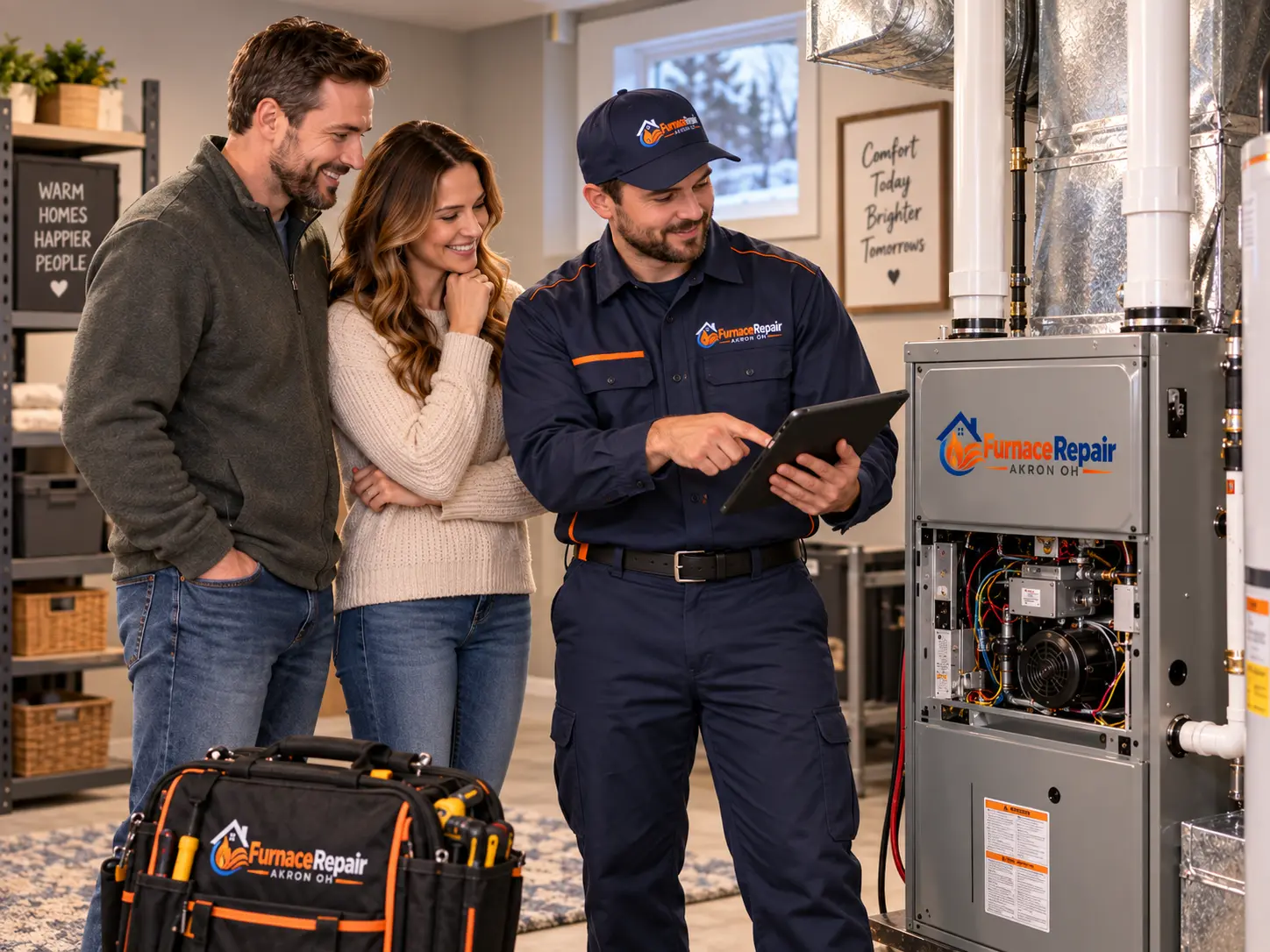
Repair Your Furnace or Replace It?
There is no single number that answers this. The right choice depends on several factors at once, and they can point the same direction once you write them down:
- furnace age
- repair history
- current condition
- current repair estimate
- replacement estimate
- efficiency
- comfort problems
- expected future repairs
The familiar advice to replace when a repair passes half the cost of replacement is one input, not a verdict. A modest repair on a furnace that fails monthly can be a poor investment, while a larger repair on a reliable mid-life system can make good sense.
Use the Furnace Repair vs Replacement CalculatorFurnace Maintenance
Maintenance is mainly about airflow, ignition and safety controls. A visit measures temperature rise against the furnace's data plate, checks the flame signal, inspects burners and venting, and verifies that limits and pressure switches work. Between visits, filter attention and clear vents handle much of the work.
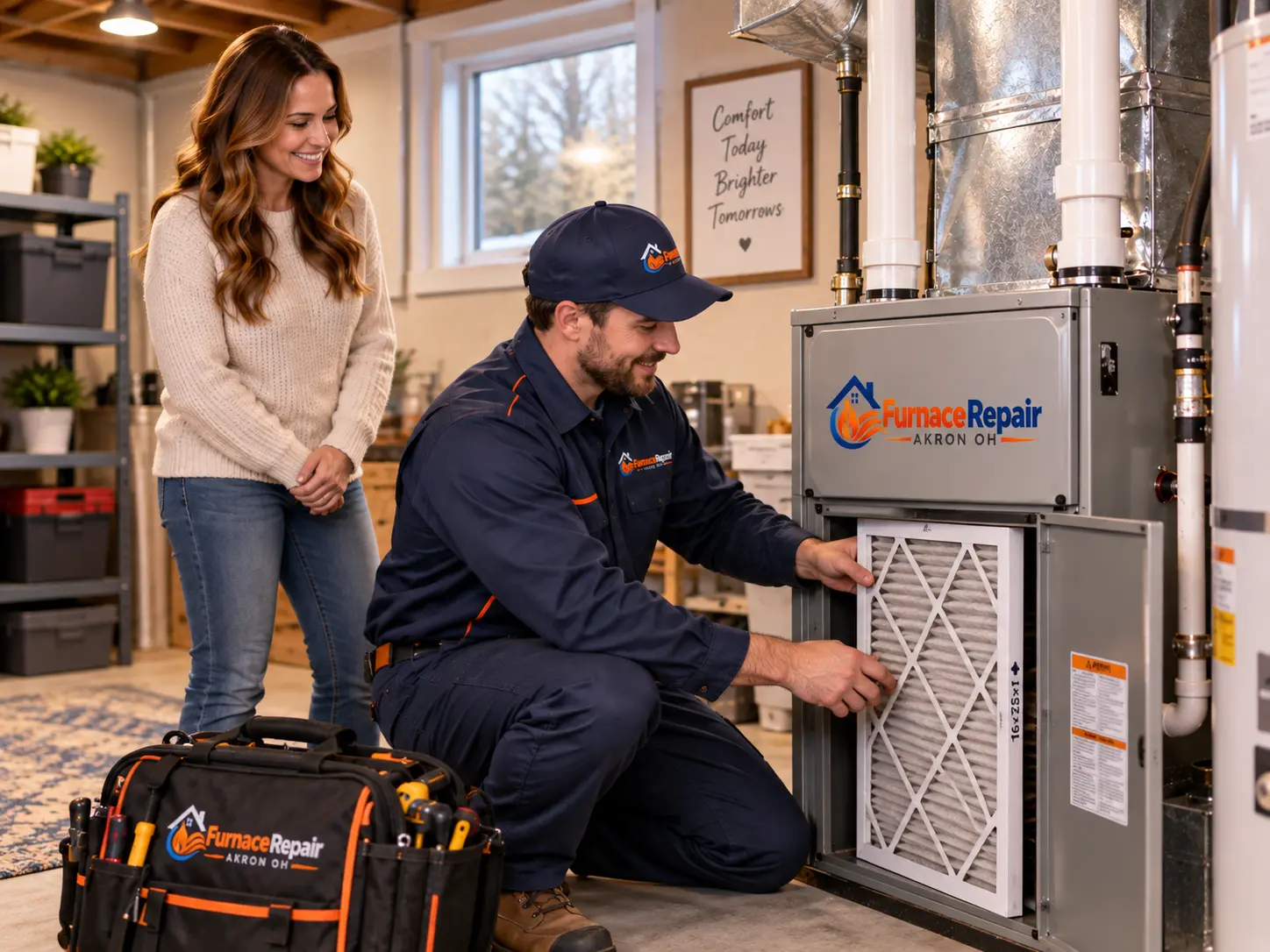
Why Furnace Problems Happen During Akron Winters
Northeast Ohio runs a long heating season. Furnaces here accumulate many hours between fall and spring, and during freezing stretches they may run nearly continuously. Runtime is what turns small problems into service calls: a marginal flame sensor becomes a lockout, a restricted filter becomes an overheating limit trip, a tired capacitor becomes a blower failure on the coldest night of the week.
Housing stock matters too. Homeowners throughout areas such as Highland Square, Firestone Park, Goodyear Heights, Ellet, Kenmore, West Akron, North Hill, Wallhaven and Merriman Valley live with very different duct systems. Some older homes have duct work added long after the house was built, with limited return air. Homes with condensing furnaces have drains and vent terminations that need to stay clear through snow and freeze-thaw cycles.
That is why two houses on the same street can have completely different comfort stories. Airflow and distribution explain more complaints than equipment brand ever does.
Furnace Service Areas
Akron is our primary service area, and we cover nearby Summit County communities and neighboring cities.
- Akron (primary)
- Furnace repair in Cuyahoga Falls
- Furnace repair in Tallmadge
- Furnace repair in Stow
- Furnace repair in Barberton
- Furnace repair in Fairlawn
- Furnace repair in Copley
- Furnace repair in Green
- Furnace repair in Hudson
- Furnace repair in Kent
- Furnace repair in Wadsworth
Homeowner Education and Resources
Guides written to answer a specific question rather than to fill a page.
Services
Guides and calculators
- Furnace repair cost guide
- Furnace repair vs replacement
- Furnace repair vs replacement calculator
- Furnace replacement cost guide
- How long furnaces last
- Furnace maintenance checklist
- Furnace filter guide
- Furnace repair FAQ
- Furnace troubleshooting guide
- Furnace maintenance tips
- Gas vs electric furnaces
- High-efficiency furnace guide
- Why heating bills increase
- Uneven heating in a home
Request Furnace Service
Send your furnace details and we will follow up about next steps and current service availability for your ZIP code.
Our Akron Business Location
Service is scheduled by phone for work at your home. Please call before visiting.
Furnace Repair Akron OH
520 S Main St, Suite 198
Akron, OH 44311
Call now FOR FREE QUOTE and for service availability.
Please have your 5-digit ZIP code ready.
Furnace Repair FAQ
- How do I know if my furnace needs repair?
- Clear signals include no heat, cool air while the blower runs, cycles that end early, new noises, uneven room temperatures, and rising heating costs without a weather change.
- Why is my furnace running but not heating?
- The blower is moving air while the burners are not lighting or are dropping out. On gas furnaces, common causes include ignition, flame sensing, venting or gas supply; on electric furnaces, common causes include elements or sequencers.
- Why is my furnace blowing cold air?
- Check the thermostat fan setting first, since Fan On circulates air between heating cycles. If the mode is Heat and the air stays cool, the burners are likely failing to light or losing flame proof.
- What causes a furnace to keep turning on and off?
- Common causes include restricted airflow from a loaded filter or blocked vents, which can cause overheating and a limit trip. Flame sensing, venting faults and thermostat placement can also cause short cycling.
- Why won't my furnace ignite?
- Common causes are a failed hot-surface ignitor, a pressure switch that never proves draft, a blocked vent or condensate drain, or a gas supply problem. Ignition components are not homeowner-serviceable.
- Can a thermostat cause a furnace to stop working?
- Yes. Without a heating call the furnace has no reason to run, so dead batteries, lost control power or a wiring error looks exactly like a furnace failure.
- What should I check before calling for furnace repair?
- Thermostat mode and setpoint, thermostat batteries, the furnace breaker, the service switch near the furnace, the air filter, and whether supply and return vents are blocked.
- When should a furnace be replaced instead of repaired?
- When age, repeated repairs, a large repair estimate relative to replacement, low efficiency, unresolved comfort problems or a safety-related finding line up together.
- How long can furnaces last?
- Gas furnaces can reach roughly 15 to 20 years and electric furnaces can last longer, though installation quality, sizing, airflow and maintenance move that range in both directions.
- Why are some rooms colder than others?
- Common causes include air distribution: long or leaky duct runs, too little return air, closed registers or dampers, plus higher heat loss in rooms above garages and on exterior corners.
- What furnace problems require immediate attention?
- A strong gas odor means leaving the home and contacting the gas utility or emergency services from a safe location. A carbon monoxide alarm means following the alarm manufacturer's emergency guidance, leaving the area if directed, and contacting emergency professionals.
- Do you serve areas outside Akron?
- Yes. We cover nearby Summit County communities and neighboring cities including Cuyahoga Falls, Stow, Tallmadge, Barberton, Fairlawn, Copley, Green, Hudson, Kent and Wadsworth. Call with your ZIP code to check current availability.